



Professor Fonagy’s ‘Prevalence Review’ final report underscores importance of expert, embedded and timely mental health support in schools

Rebecca is a practising counsellor, having worked across schools, communities, and in private practice since 2002. She has written books covering various aspects of clinical practice with children. Rebecca led an MA at the University of Roehampton in counselling for children and young people, also completing PhD research in this area. Rebecca joined Place2Be from BACP, where she was the Accreditation Lead. Rebecca was appointed Clinical Director in 2024.
Place2Be welcomes the final report of Professor Peter Fonagy’s Independent Review into Mental Health Conditions, ADHD and Autism, which makes clear that rising distress amongst children and young people is real but that far too many are still going without the support they need, when they need it.
What does the report tell us?
Rising distress amongst children is real
Too many go without the support they need
We need to intervene early in a child’s life and as soon as problems arise
At Place2Be we agree that crisis or diagnosis cannot be the only routes to mental health support – with half of all mental health problems presenting before the age of 14, we need to intervene early to prevent problems escalating, and build a culture where good mental health is valued, supported and nurtured every day so that children can thrive.
Indeed, our own data, shared with the Review, that the prevalence, level and impact of mental health difficulties of children aged 4 to 11 has increased since 2020, according to their parents. The Review now underscores the need to intervene early.
The challenge in meeting need early is not simply one of capacity, but of system design. Too many children with moderate and complex needs are left without appropriate support while waiting for problems to escalate to meet specialist thresholds. We agree with the review that we need to close the gap in provision for this ‘missing middle’ of children.
Current support is inadequate: Too many children with moderate and complex needs are left without support while waiting to meet thresholds.
The government’s Mental Health Support Teams (MHSTs) are a welcome baseline of provision, but are limited in their clinical expertise, spread too thinly to make real impact in schools, and hampered by workforce recruitment and retention challenges.
By contrast, evidence from across the sector – including Place2Be’s work and from integrated models such as Greater Manchester – demonstrates that sustained school-based mental health expertise can bridge the gap in provision between MHSTs and CAMHS effectively and cost-efficiently. It means children can access the right support, in the right place at the right time based on their needs.
The solution: Expert, embedded, and timely whole-school mental health support that is part of the school community.
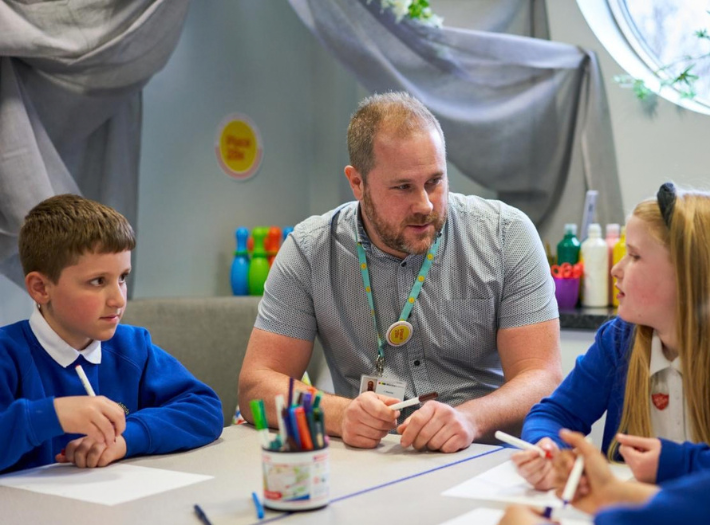
Our experience and evidence from over 30 years of working in schools’ points to the value of expert, embedded, and timely whole-school mental health support: a trusted practitioner who is part of the school community, supports children, families and staff, and connects with wider services.
We welcome the review’s emphasis on triage according to a young person’s difficulties and ability to cope in everyday settings. Indeed, an embedded model like Place2Be’s can identify need early, understand how difficulties are presenting in class or with peer relationships, and respond before problems escalate or become dependent on diagnoses or specialist clinical pathways.
This model delivers the kind of graduated response described in the review too. Universal support to influence whole school culture change and promote good mental health and wellbeing, through to targeted help for children and families who need more focused intervention. We also go beyond the school gates, recognising that children’s needs are shaped by the wider systems around them.
The evidence: most children supported through our targeted interventions improve mental health, classroom learning, behaviour and engagement, with improvements sustained after a year. Our Whole School Approach strengthens staff confidence, family engagement and pupil connection to school.
We deliver this model in schools across the UK, and our evidence finds that most children and young people supported through targeted interventions see improvements in mental health, benefiting classroom learning, behaviour and engagement. New research, funded by the City Bridge Foundation, also shows that improvements in mental health following our 1-1 interventions are sustained after a year.
Our Salford research programme, funded by AL Philanthropies, which looked at our impact in 20 schools in the area, has also shown the value of consistent support, including stronger staff confidence, family engagement and pupils feeling a greater sense of connection and belonging in their school.
This model of support should be part of the infrastructure put in place to deliver the review’s ambitions: accessible, proportionate, needs-led support that reaches children earlier; strengthens the capacity of trusted adults around them; and helps ensure that specialist pathways are reserved for those who will benefit most from formal diagnosis or clinical intervention.
Professor Fonagy’s report adds to this wealth of evidence on what works to improve children’s mental health – now we need action.